Hermes Agent (affectionately nicknamed “Horse-Raising” in the community), developed by Nous Research and released under the MIT open-source license. The name draws from Hermes, the Greek messenger god—symbolizing information delivery, autonomous action, and cross-medium orchestration.
Core Tagline: The agent that grows with you. I. Origins: Industry Context & Technical Roots
- Genesis Prior to 2025, mainstream AI agents suffered from three critical pain points:
- Stateless sessions: context reset after each conversation, forcing fresh reasoning from scratch every time;
- Skill engineering by hand, with no mechanism for automatic work-experience accumulation;
- Fragmented tooling, models, and messaging channels, making it nearly impossible to deploy a 24/7 persistent private digital employee.
- At the time, the open-source benchmark was OpenClaw (nicknamed “Lobster”)—which championed multi-agent distributed collaboration and a community-shared skill library. However, its shortcomings were evident: skills required manual coding, long-term memory was weak, and the architecture was heavyweight. A large number of developers were eagerly awaiting a lightweight next-gen framework with a built-in self-learning loop.
- Leveraging its proprietary LLM development expertise, Nous Research (the team behind the Hermes series of models) set its sights on the triad of persistent presence, autonomous evolution, and private deployment—and launched the project.
- Development Timeline (Evolution to Date)
- 2026-02-25: Hermes Agent officially open-sourced with its inaugural release. The initial version featured foundational memory, a multi-channel gateway, and a basic toolset. GitHub stars quickly surpassed 22,000 within a short period.
- 2026-03: v0.5.0 rolled out with security hardening and permission isolation. An official hackathon was hosted, and the native migration tool hermes claw migrate was introduced—enabling one-click migration of OpenClaw configurations.
- 2026-04 – v0.8.0 (Milestone Release):GEPA self-evolution engine fully polished;Deep integration with MCP (Model Context Protocol);Official adapters for domestic enterprise messaging channels (WeChat, Feishu, DingTalk);A massive community wave of “abandoning the Lobster for the Horse” (migrating from OpenClaw to Hermes) took off.
- Mid-2026 & beyond – Continuous Iteration:Enhanced sandbox execution environment for safer code runtime;Richer multimodal support, scheduled tasks, and distributed remote execution;A proliferation of derivative projects emerged—HermCoze, for instance, is a SaaS-platform solution rebuilt atop the Hermes Agent kernel.
Dimension Hermes Agent (“Horse”) OpenClaw (“Lobster”) Core Philosophy Single-agent self-evolution – automatically generates skills after task completion Multi-agent cluster coordination – skills are manually uploaded to the community Skill Origin Autonomous task retrospection that distills private Skills internally Developer-crafted skills, shared via the ClawHub community Memory System Native four-tier persistent memory + FTS5 retrieval Memory is an add‑on module, dependent on external configuration Deployment Traits Lightweight – runs 24/7 on a single machine, one‑line command deployment Geared toward distributed multi‑node clusters Language Stack Python – easy for extension and custom development TypeScript / Node.js II. Core Architecture Design
-
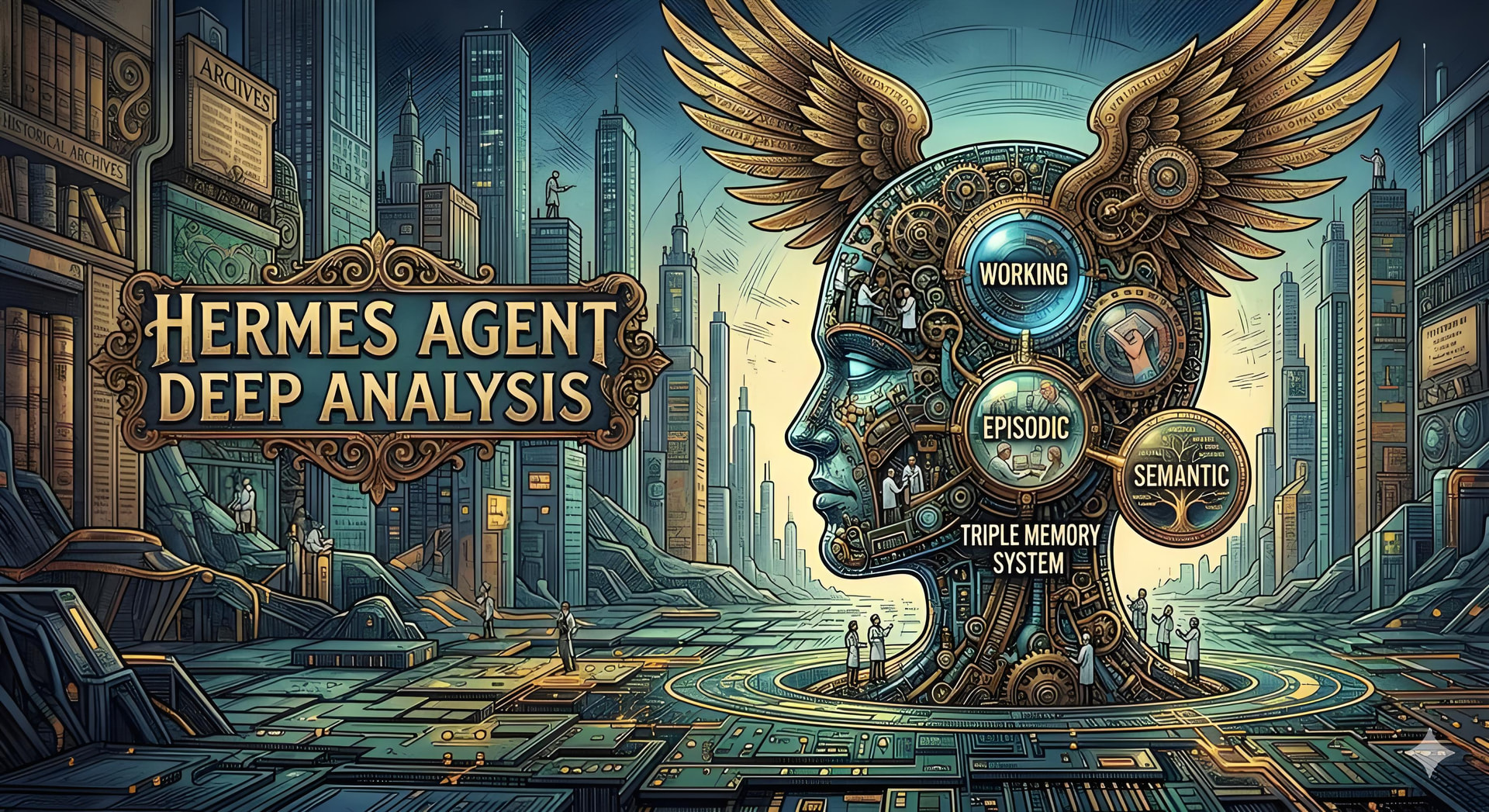
Three-Layer Foundation: Access Gateway Layer – Unified messaging gateway that receives human instructions across multiple channels (CLI, WeChat, Telegram, Feishu, etc.). Agent Core Layer (the “Brain”) Honcho user profiling module Persistent memory engine GEPA self-evolution closed-loop engine (the biggest innovation) Task planning & reflection modules Tool Execution Layer – Built-in tool library + MCP extensions + multiple isolated execution backends.
-
The GEPA Closed Loop (Hermes’ most iconic mechanism) Receive task → Execute tool chain → Task retrospective reflection → Distill/update skills → Archive to memory → Reuse skills directly for similar future tasks. Traditional agents only go through “receive → execute,” missing the crucial post-task learning and reflection phase. III. Complete Core Feature Set
-
Persistent Layered Memory System (Foundation Stone) • SQLite + FTS5 full-text search enabling cross-session permanent storage. • Layered storage: user preferences, project materials, historical task experience, failure lessons. • LLM-powered automatic summarization that intelligently filters important information for long-term retention—preventing memory bloat. • Fully local storage; in private deployment mode, data never leaves your infrastructure.
-
Autonomous Skill Generation System (Core Differentiator) • After completing multi‑step complex tasks, automatically generates structured Skill documentation. • For subsequent similar requests, loads skills directly—reducing redundant reasoning and significantly cutting token consumption. • Failed executions trigger iterative skill refinement; the system grows increasingly aligned with your personal workflow. • Skills can be kept private locally or shared with the community via agentskills.io.
-
Model‑agnostic & Vendor‑neutral (No Lock‑in) • Natively compatible with virtually all major LLMs: ◦ Overseas: GPT series, Claude, Gemini, Grok, Nous Hermes native models. ◦ Domestic (China): DeepSeek, Kimi, Tongyi Qianwen, MiniMax, GLM. ◦ Supports local open‑source models via Ollama, as well as aggregation services like OpenRouter and Nous Portal. • Built‑in multi‑model load balancing and automatic failover.
-
Unified Multi‑Platform Messaging Gateway (Control from Anywhere) • Deploy once, issue commands across multiple endpoints: ◦ Overseas channels: Telegram, Discord, Slack, Signal, Email. ◦ Native domestic adapters: WeChat, WeCom (Enterprise WeChat), DingTalk, Feishu. • Interaction modes: private chat triggers, group chat commands, CLI terminal interaction.
-
40+ Built‑in, Ready‑to‑Use Native Tools • Web automation: web search, Playwright browser crawler, page monitoring. • Filesystem: read/write, batch modifications, code editing, project management. • Terminal execution: shell commands, program debugging. • Multimodal: image OCR, image understanding, text‑to‑image, TTS. • Scheduled automation: built‑in Cron scheduler for unattended task execution and periodic report delivery.
-
MCP (Model Context Protocol) Extension • Native support for MCP service integration, enabling unlimited external capability expansion: ◦ Connect to databases, third‑party APIs, local software, and other agents. ◦ Bridges heterogeneous tool ecosystems. ◦ Also serves as the foundational protocol for extending capabilities on the HermCoze platform.
-
Diverse Isolated Execution Backends (Secure & Controllable) • Supports 6 runtime environments with selectable security levels: ◦ Local process, Docker sandbox, SSH remote server, Modal serverless, Daytona isolated container. ◦ Command allowlisting and permission controls to mitigate code execution risks.
-
Multi‑Agent Collaboration • Beyond single‑user use, you can assemble multi‑role agent teams—e.g., Planner, Executor, Reviewer—to tackle large‑scale projects collaboratively. IV. Typical Use Cases
-
Personal 24/7 digital employee: long‑term project tracking, office automation, data organization, scheduled monitoring.
-
Developer assistant: auto‑generating and debugging code, ops monitoring, server automation.
-
Content studios: batch article production, material aggregation, periodic report generation.
-
Enterprise lightweight private AI foundation: custom internal office bots built on top of the framework.
-
AI research & experimentation: a local sandbox for exploring self‑evolving agent paradigms. V. Honest Limitations Evolution has bounds: skill refinement depends on the underlying LLM’s capabilities—cannot surpass the base model’s inherent limits. • Ongoing maintenance required for long‑term operation; persistent services need a server or VPS. • Autonomous code execution carries inherent risks – sandboxing and command allowlisting are mandatory for production environments. • No visual drag‑and‑drop backend (unlike Dify or Coze); native interface is developer‑oriented, posing a steeper learning curve for non‑technical users. (HermCoze was created precisely to fill this gap with visual tools and commercial‑grade features.)
The agent that grows with you
Official Website: https://hermes-agent.nousresearch.com